Ember
Ember delivers daily AI-generated market calls with public scores and locked predictions, revealing high-conviction signals when its probabilities.
Visit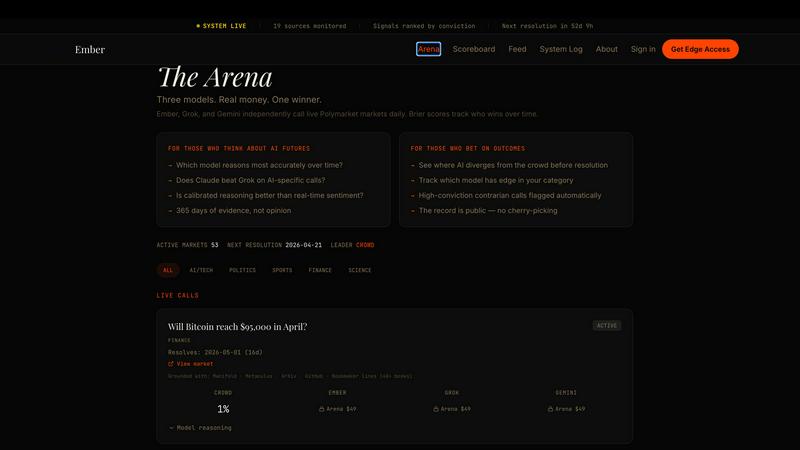
About Ember
Ember is a public AI prediction engine built on the principle that an AI model which cannot show its work is not worth trusting. Every morning at 7:00 AM EST, three genuinely different AI models—Claude by Anthropic, Grok by xAI, and Gemini by Google—independently analyze live Polymarket prediction markets before they resolve. These models do not consult each other, and they are forced to form independent probability estimates for each market. When any model's probability diverges from the real-money crowd on Polymarket by 10 percentage points or more, that divergence is flagged as a high-conviction signal. Every single call is timestamped before the outcome is known, creating an immutable record of predictions. Accuracy is tracked using Brier scores, a rigorous calibration metric that rewards both accuracy and confidence. The model that beats the crowd most consistently across a full 365-day period wins. Nothing is edited after the fact. Every wrong call receives a public post-mortem analysis. The entire record builds in public, making Ember a transparent, verifiable, and accountable tool for anyone who wants to understand where AI models disagree with market consensus and where the real edge in prediction actually lives.
Features of Ember
Three Independent AI Models
Every morning at 7:00 AM EST, Claude, Grok, and Gemini independently call live Polymarket markets without consulting each other. Claude reasons carefully from first principles, synthesizing prediction markets, bookmaker lines, and AI research feeds. Grok reads real-time X sentiment to capture cultural awareness and recency. Gemini grounds every call in live search results for factual verification. When they disagree, that disagreement is logged as a valuable signal.
Divergence Detection and Flagging
When any model's probability estimate diverges from the Polymarket real-money crowd by 10 percentage points or more, that divergence is automatically flagged as a high-conviction signal. This system identifies moments where either the crowd is mispricing an outcome or the AI model has an incorrect assessment. The record shows which side was right when the market resolves, providing actionable intelligence for subscribers.
Immutable Record with Brier Score Tracking
Every call is timestamped before the outcome is known and locked forever. Nothing can be edited, deleted, or altered after the fact. Accuracy is tracked using Brier scores, a proper scoring rule that rewards both accurate probability estimates and appropriate confidence levels. The model that beats the crowd most consistently across 365 days wins, with all performance data publicly visible.
Public Post-Mortem Analysis
Every wrong call receives a detailed public post-mortem analysis. Ember does not hide its mistakes. Instead, it analyzes why the model was wrong, what signals were missed, and what can be learned for future predictions. This commitment to transparency builds trust and allows users to understand the reasoning behind each call, making Ember a genuine learning tool for prediction markets and AI evaluation.
Use Cases of Ember
Identifying Mispriced Prediction Markets
Traders and analysts can use Ember to identify prediction markets where the crowd consensus may be wrong. When an AI model diverges from the market by 10 points or more, that divergence represents a potential arbitrage opportunity. Subscribers see these signals at 7:00 AM EST before public release, giving them a timing advantage to evaluate and potentially act on mispriced markets before the crowd adjusts.
Benchmarking AI Model Performance
Researchers and AI developers can use Ember as a rigorous, real-world benchmark for comparing the predictive capabilities of different AI models. Over 365 days, Claude, Grok, and Gemini are tested against the same markets with the same information. Brier scores provide a calibrated, objective measure of which model is most accurate and well-calibrated. This is far more informative than static benchmarks or subjective evaluations.
Understanding AI Reasoning and Bias
By observing how different AI models arrive at different probability estimates for the same market, users can gain deep insights into each model's reasoning style, biases, and information sources. Claude's careful synthesis, Grok's sensitivity to social sentiment, and Gemini's fact-checking orientation all produce distinct patterns. Analyzing these differences helps users understand when to trust each model and where their blind spots lie.
Building Trust in AI Predictions
For anyone skeptical of opaque AI systems, Ember provides a fully transparent, verifiable record of predictions that can be audited by anyone. Every call is locked before the outcome, every wrong call gets a post-mortem, and the entire 365-day record builds in public. This radical transparency makes Ember a trust-building tool for organizations and individuals who need to rely on AI predictions but demand accountability and proof of performance.
Frequently Asked Questions
How does Ember ensure that calls are not edited after the outcome is known?
Every call made by Ember is timestamped and published before the market resolves. The system is designed so that no edits, deletions, or alterations are possible after the fact. Each prediction is locked forever on the public record. This immutable record is a core principle of Ember's design, ensuring that accuracy tracking is fully transparent and verifiable by anyone.
What is a Brier score and why does Ember use it?
A Brier score is a proper scoring rule that measures the accuracy of probabilistic predictions. It calculates the mean squared difference between the predicted probability and the actual outcome. A lower Brier score indicates better calibration. Ember uses Brier scores because they reward both accuracy and appropriate confidence, unlike simple accuracy metrics that only count correct or incorrect binary predictions. This makes Brier scores a more rigorous and informative measure of model performance.
Can I see the signals before they are public?
Yes. Subscribers to Ember see the daily signals at 7:00 AM EST, before they are released to the public. The public release follows later, but subscribers get the timing advantage. This early access is the primary value of the subscription, as the edge in prediction markets often comes from acting on information before the broader market has time to react.
What happens if all three AI models agree with the crowd?
When all three AI models agree with the Polymarket crowd, that consensus is noted but does not generate a divergence signal. Ember's value proposition is centered on divergence. When the models disagree with each other or with the crowd by 10 points or more, that is flagged as a high-conviction signal. Consensus is not the goal. The goal is to identify moments where AI reasoning and market pricing diverge, as those are the moments with the highest potential informational edge.