
moki - startup idea validation. you need
moki scores startup ideas as Make, Hold, or Kill by analyzing fatal flaws and market demand before you waste three months.
Visit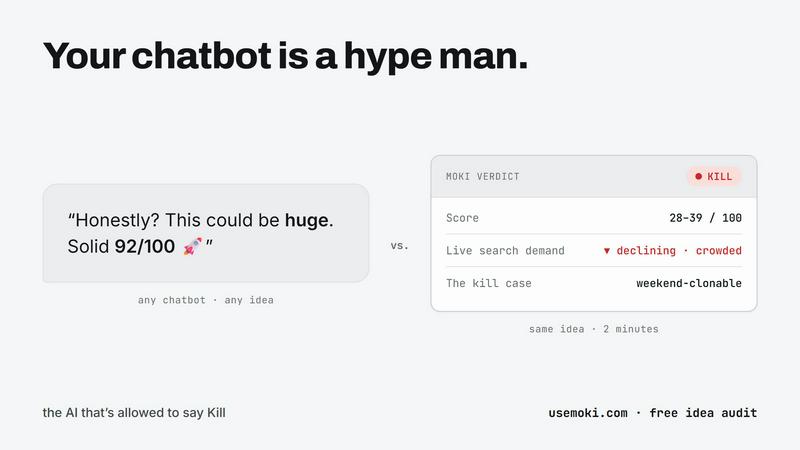
About moki - startup idea validation. you need
moki is a startup idea validation tool designed for founders, product managers, and innovators who have more ideas than time. It provides a structured, evidence-based framework to evaluate whether an idea deserves a Make, Hold, or Kill verdict before you commit months of effort. Unlike typical validation tools that cheerlead or provide vague feedback, moki is built to deliver honest, reasoned kill calls quickly. It combines a fixed academic method with live Google search demand data, offering a clear analysis of an idea's fatal flaw, the factor dragging it down, what would flip the verdict, and the cheapest experiment to settle the uncertainty. The process takes about two minutes, requires no signup for the first idea, and avoids lengthy onboarding questionnaires. moki is for anyone who needs a faster no, not another idea. It pulls live search demand to distinguish between genuine buying intent and mere applause, ensuring you base decisions on real market signals. The tool scores ideas across six weighted factors, presenting each as a confidence range rather than a single fake number. This approach surfaces the binding constraint so you can fix the most critical issue, not everything at once. moki is a free side tool that helps you avoid wasting three months on ideas that deserve a kill verdict.
Features of moki - startup idea validation. you need
Honest Make / Hold / Kill Verdict
moki delivers a clear verdict based on a decision rule with three zones. If the worst case score is at least 65, the verdict is Make. If the best case score is 40 or below, the verdict is Kill. For scores in between, moki provides a Hold verdict with specific guidance: gather evidence if the band is wide (high uncertainty), or reshape or kill if the band is tight and mediocre. This eliminates vague scores and gives you a concrete call.
Live Google Search Demand Analysis
moki pulls live Google search demand data that reflects what people are actually searching for this week, not what a chatbot remembers from training. It analyzes buying-intent queries, 12-month trends, competition levels, and market maturity. This feature distinguishes genuine market demand from superficial applause, ensuring you validate against real buying behavior rather than polite feedback.
Six Weighted Factor Scoring
The tool evaluates your idea across six weighted factors: differentiation, market attractiveness, financial reward, risk (inverse), and others. Each factor is scored as a confidence range, such as 2-4 out of 10, rather than a single false number. moki surfaces the weakest factors dragging down the overall score, allowing you to focus on the binding constraint that matters most.
Adversarial Kill Case and Next Move
moki generates an adversarial kill case that identifies the fatal flaw in your idea. It then specifies what would flip the verdict to Make, whether that change is reachable, and the cheapest experiment to shrink the biggest unknown. For example, it might recommend a pre-sell before building or a specific market pivot. This feature provides actionable next steps, not just criticism.
Use Cases of moki - startup idea validation. you need
Validating a New Startup Idea Before Building
A solo founder with a concept for an AI Slack bot that auto-summarizes support tickets can use moki to get a quick Kill verdict. The tool reveals the weakest link is market attractiveness, the kill case is that it is weekend-clonable with no way to get found, and live search demand is declining and crowded. This saves the founder from wasting three months on a doomed idea.
Prioritizing a Pipeline of Business Ideas
A product manager juggling multiple ideas can use moki to triage them quickly. By scoring each idea in about two minutes, they can identify which ones deserve a Make verdict and which should be killed or held. This helps allocate resources efficiently and avoid committing to ideas with fatal flaws like saturated markets or weak differentiation.
Testing Market Demand Before a Pivot
An existing startup considering a pivot can run their new idea through moki to check live search demand and buying intent. If the demand read is thin and the trend is declining, moki provides a reasoned kill call with evidence. This prevents the team from pivoting into an equally dead end and guides them toward ideas with genuine market pull.
Evaluating Side Projects for Feasibility
A developer or creator with a side project idea can use moki to determine if it is worth pursuing. The tool identifies the fatal flaw and the cheapest experiment to prove the idea wrong. For instance, if the idea has a wide band of uncertainty, moki advises gathering cheap evidence before investing significant time or money.
Frequently Asked Questions
What is the difference between Make, Hold, and Kill verdicts?
Make means the idea clears the bar with a worst case score of 65 or higher, indicating strong potential. Kill means the best case score is 40 or below, meaning the idea is not viable. Hold is for ideas that fall in between, with moki providing specific guidance: gather evidence if the score band is wide (uncertainty is high), or reshape or kill if the band is tight and mediocre (the idea is consistently average but not good enough).
How does moki measure market demand?
moki pulls live Google search demand data, analyzing buying-intent queries, 12-month trends, competition levels, and market maturity. This data reflects what people are searching for this week, not historical training data. It distinguishes between genuine buying intent and mere applause, ensuring you validate against real market signals rather than polite feedback.
Do I need to sign up to use moki?
No, your first idea is free and requires no signup. The process takes about two minutes with no 40-question onboarding. You simply input your idea and receive a verdict with the fatal flaw, what would flip it, and the cheapest experiment. Additional ideas may require signup, but the first one is completely free and anonymous.
What factors does moki use to score an idea?
moki scores ideas across six weighted factors, including differentiation, market attractiveness, financial reward, and risk (inverse). Each factor is scored as a confidence range, such as 2-4 out of 10, rather than a single number. The tool surfaces the weakest factors dragging down the overall score, allowing you to focus on fixing the binding constraint that matters most.
Pricing of moki - startup idea validation. you need
moki offers a free tier where the first idea validation is completely free with no signup required. The website does not provide details on any paid tiers or subscription plans. Additional pricing information is not available in the provided context.
Explore more in this category:
Similar to moki - startup idea validation. you need
TchoAI
Turn documents, notes, and data into clear, editable presentations in minutes.
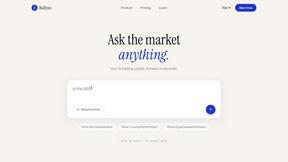
Bullynx
Upload any chart or ask any market question and get a clear, honest read in seconds.
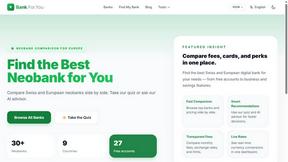
Bank.For.You
Compare Swiss and European neobanks side by side using a quick quiz or AI advisor to find your ideal digital bank.

iPulse
iPulse delivers AI-driven market intelligence with real-time forecasts, signals, and risk insights across global assets.