act101
act101 is a native Rust binary with 163 grammars that lets AI agents perform language-aware code refactoring and porting across languages.
Visit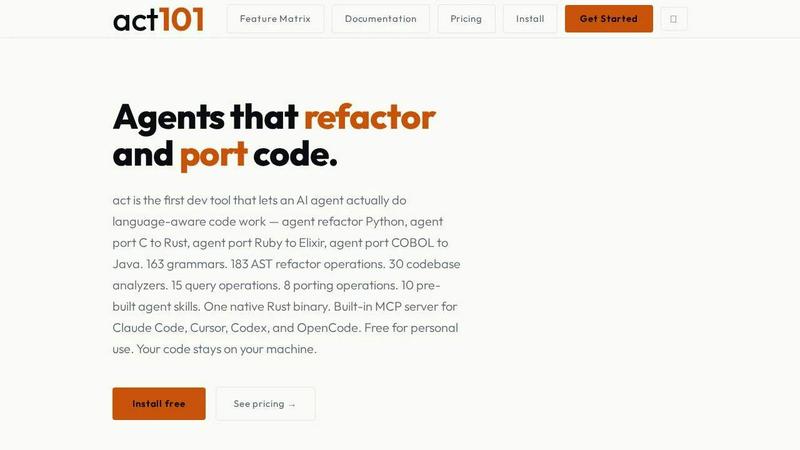
About act101
act101 is a groundbreaking developer tool that fundamentally changes how AI coding agents interact with source code. Unlike traditional AI coding assistants that rely on whole-file rewrites or simple text-based modifications, act101 provides a comprehensive Model Context Protocol (MCP) server that exposes over 183 Abstract Syntax Tree (AST)-aware refactor operations, 30 codebase analyzers, 15 query operations, and 8 specialized porting operations across an impressive 163 programming languages. Built as a single native Rust binary, act101 eliminates the need for plugin runtimes, package dependencies, or external indexing services, ensuring your code never leaves your machine. The tool is designed for developers using AI coding agents like Claude Code, Cursor, Codex, and OpenCode, providing them with the ability to perform precise, language-aware code transformations such as extracting functions, renaming symbols across entire workspaces, converting data structures, and even porting entire codebases from one language to another. By operating directly on the AST level, act101 achieves approximately 85% fewer tokens than file-based operations, making it both efficient and accurate. The tool is free for personal use and includes automatic checkpointing with instant undo capabilities, ensuring safe experimentation with code transformations.
Features of act101
AST-Aware Refactor Operations
act101 provides AI agents with access to 183 distinct AST-aware refactor operations that go far beyond simple text replacements. These operations include extract-function, rename, move-symbol, inline, convert-to-dataclass, extract-trait, add-type-hints, generate-init, organize-imports, and 174 more specialized transformations. Each operation understands the syntactic and semantic structure of the target language, ensuring that comments are preserved, formatting remains intact, and cross-file references are updated consistently. The tool automatically creates checkpoints before each operation and provides instant undo capabilities, allowing developers to experiment freely without fear of breaking their codebase.
Multi-Language Porting Engine
The porting engine is a revolutionary feature that enables AI agents to perform end-to-end language migrations through a sophisticated state machine consisting of contract, inventory, ordering, and manifest phases. Using the port_contract operation, the agent anchors the source-to-target migration strategy. The port_inventory operation enumerates every symbol that must be moved, while port_order resolves dependency ordering to ensure logical progression. The port_manifest state machine tracks progress through init, add, update, remove, and note phases. This system works seamlessly between any two of the 163 supported grammars, enabling migrations such as C to Rust, Ruby to Elixir, or COBOL to Java.
Comprehensive Codebase Analyzers
act101 includes 30 built-in codebase analyzers that provide AI agents with deep structural understanding of any codebase before making modifications. These analyzers cover cohesion analysis, coupling detection, cycle identification, chokepoint discovery, hot spot detection, dead code elimination, layer analysis, seam identification, cluster analysis, surface analysis, fan balance measurement, migration readiness assessment, and type completeness evaluation. Each analyzer produces actionable insights that help agents make informed decisions about refactoring strategies, identify problematic areas, and understand the architectural implications of their changes.
Pre-Built Agent Skills
The platform comes with 10 pre-built agent skills that compose individual operations into complete engineering workflows. These skills include architecture-audit, code-review, refactoring, code-navigation, code-generation, migration-assessment, boundary-analysis, change-impact, health-check, and architectural-refactoring. Each skill can be invoked using the /skill-name command in supported AI coding environments like Claude Code, Cursor, and Co. These skills automate complex, multi-step processes that would otherwise require significant manual orchestration, making the tool accessible to developers of all skill levels.
Use Cases of act101
Modernizing Legacy Codebases
Development teams working with legacy code in languages like COBOL, Fortran, or older versions of Java can use act101 to systematically modernize their codebases. The porting engine allows agents to analyze the existing code structure, identify dependencies, and execute controlled migrations to modern languages like Java, C#, or Python. The 30 codebase analyzers help identify dead code, coupling issues, and migration readiness before any transformation begins, ensuring a smooth transition with minimal risk of introducing errors.
Cross-Language Microservice Migration
Organizations migrating their monolithic applications to microservices often need to translate specific components between languages. act101 enables AI agents to port individual services from one language to another while maintaining business logic integrity. For example, a team can port a Ruby-based service to Elixir for better concurrency, or migrate a C library to Rust for improved memory safety. The contract and inventory state machine ensures that every function, variable, and dependency is accounted for during the migration process.
Large-Scale Code Refactoring
Engineering teams tackling major refactoring initiatives can leverage act101 to perform complex transformations across entire codebases. Whether it is extracting functions from monolithic methods, renaming symbols across hundreds of files, moving modules between directories while updating all imports, or converting data structures to use modern patterns, act101 provides the precision and consistency required for large-scale refactoring. The automatic checkpointing and instant undo features make it safe to experiment with aggressive refactoring strategies.
Architecture Compliance and Auditing
Software architects and technical leads can use act101 to enforce architectural standards and conduct regular codebase health checks. The pre-built architecture-audit and boundary-analysis skills provide comprehensive reports on coupling patterns, dependency cycles, layer violations, and other architectural metrics. Teams can integrate these skills into their CI/CD pipelines to automatically verify that new code additions do not violate established architectural boundaries or introduce unwanted dependencies.
Frequently Asked Questions
What programming languages does act101 support?
act101 supports an impressive 163 programming languages through its built-in grammars. This includes all major languages like Python, JavaScript, TypeScript, Rust, Go, Java, C, C++, Ruby, Elixir, COBOL, Fortran, and many more specialized and legacy languages. The grammars are compiled directly into the single native Rust binary, so there is no need to download additional language support packages or configure external parsers. Support for new languages is continuously being added to keep pace with the evolving development landscape.
How does act101 ensure code safety during transformations?
act101 implements multiple layers of safety mechanisms to protect your code. First, every operation is AST-aware, meaning it understands the syntactic and semantic structure of the code rather than treating it as plain text. This prevents common issues like broken syntax, misplaced comments, or malformed formatting. Second, the tool automatically creates checkpoints before each operation, allowing instant rollback to any previous state. Third, all operations are performed locally on your machine with no telemetry or external data transmission, ensuring your intellectual property remains secure.
Can act101 work with my existing AI coding tools?
Yes, act101 is designed as a Model Context Protocol (MCP) server that integrates seamlessly with popular AI coding agents. It works out of the box with Claude Code, Cursor, Codex, and OpenCode. The built-in MCP server exposes all 183 refactor operations, 30 analyzers, 15 queries, and 8 porting operations as standardized tools that these agents can call directly. This means you can continue using your preferred AI coding environment while gaining access to act101's powerful code transformation capabilities.
Is act101 free to use and what are the limitations?
act101 is free for personal use, allowing individual developers to leverage its full capabilities for their own projects. The free tier includes access to all 163 grammars, all 183 refactor operations, all 30 analyzers, all 8 porting operations, and all 10 pre-built agent skills. For commercial or team usage, act101 offers paid pricing plans that provide additional features such as team management, priority support, and usage analytics. License verification may contact our servers periodically, but your actual code never leaves your machine.
Pricing of act101
act101 offers a tiered pricing structure designed to accommodate different usage levels. The Personal plan is free and includes full access to all features for individual developers working on personal projects. The Team plan is available for small development teams and includes additional features such as shared project management, team analytics, and priority support. The Enterprise plan provides custom pricing for large organizations and includes dedicated support, custom integrations, and advanced security features. For the most current pricing information, please visit the act101 pricing page on the official website.
Similar to act101

Product Launch Checklist
A free launch checklist for SaaS, apps, AI tools and more. Every step says why it matters and when you can skip it.
Forms Plugin
The #1 Native Form Builder Plugin for Framer - No Code, No Embeds, No External Platforms.
VidhyaGen
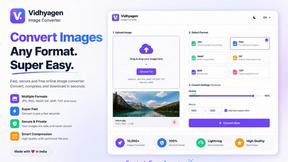
Fast, free, and privacy-first browser tool to convert, crop, resize, and compress images locally without server uploads.
PNG to SVG
Convert PNG and JPG images to SVG, compress images, and switch between popular formats directly in your browser. No uploads, no signup, and no waterma

xDevTools
Fast, private developer tools. 1000+ utilities run locally. Format, encode, hash, and analyze.